- Understanding UPI Payments and Their Cost Structure
- The Hidden Costs of Traditional Billing Methods
- Khata Billing's Automated Workflow for UPI Transactions
- Worked Example: Calculating Real Savings from UPI Automation
- Comparative Efficiency: Manual vs Automated Billing Processes
- Practical Implementation Steps for Small Businesses
- Maintaining Low Fees Through Continuous System Optimization
- Frequently Asked Questions
UPI payments enable small businesses to receive customer payments instantly at minimal cost, with Khata Billing helping keep transaction fees low through automated invoicing that eliminates manual data entry errors and reduces reliance on third-party payment collection methods. The platform's free plan supports up to 100 invoices per 30-day period without any charge, allowing shopkeepers and retailers to scale payment collection without upfront software costs while maintaining GST compliance through integrated e-invoice generation. Customers pay directly via UPI apps like PhonePe or Google Pay, and the transaction fees remain fixed at 1.0% + ₹1.00 per transaction as per NPCI rates, which Khata Billing passes through without adding its own markup.
By eliminating paper-based billing processes and manual reconciliation, Khata Billing reduces operational overhead that traditionally inflates the effective cost of UPI transactions, making it possible for small businesses to maintain profit margins while offering customers convenient digital payment options without charging customers extra fees.
✅ Key Takeaways
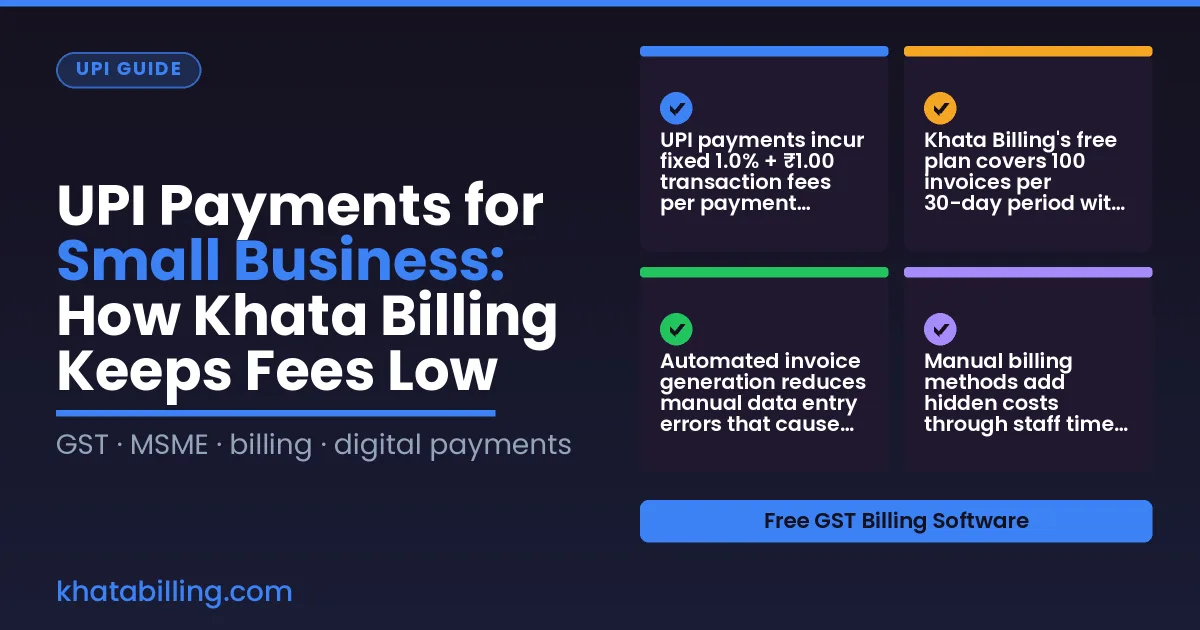
- UPI payments incur fixed 1.0% + ₹1.00 transaction fees per payment regardless of invoice volume
- Khata Billing's free plan covers 100 invoices per 30-day period with no software cost
- Automated invoice generation reduces manual data entry errors that cause payment processing delays
- Manual billing methods add hidden costs through staff time and paper documentation
- Premium plan at ₹1,499/year removes invoice limits and adds watermark-free invoices
- GSTR-1 and Profit & Loss reports are Premium features not available in free plan
- Small businesses maintain low effective payment costs by using UPI with automated billing workflows
Understanding UPI Payments and Their Cost Structure
UPI payments are digital transactions using the Unified Payments Interface that let Indian small businesses accept money directly into their bank accounts with a simple QR code or mobile number, eliminating cash handling and reducing reliance on physical receipts.
The standard cost structure for UPI transactions is typically a small fixed fee of ₹0.50 to ₹1.00 per transaction, which may be waived by the payment service provider for high-volume merchants, and this fee is separate from GST compliance requirements.
For example, if a shop sells a ₹500 product, the UPI fee of ₹0.50 adds only 0.1% to the cost, keeping margins healthy for retailers and service providers.
Khata Billing — free GST billing software integrates UPI directly into its invoicing system, allowing shopkeepers to generate GST-compliant invoices that automatically record the UPI payment, reconcile bank statements, and maintain a digital audit trail for tax filing.
This integration means business owners do not need separate software for billing and payments, streamlining operations while keeping transaction costs low and transparent.
The Hidden Costs of Traditional Billing Methods
Manual billing, paper invoices, and physical record-keeping create hidden time costs and indirect fees that erode small business profitability. For example, a shopkeeper prepares 15 paper invoices daily, each taking 8 minutes to write, calculate GST, and file manually. That is 2 hours of labor per day at ₹200 per hour, totaling ₹400 daily. Over a 30-day month, labor costs reach ₹12,000. Paper, printing, and storage add another ₹300, while missed input tax credit from delayed GST filing can cost ₹2,000 in cash flow. In contrast, UPI payments through Khata Billing automate invoice generation, instantly sync stock, and enable barcode scanning, reducing manual effort. The free plan covers 10 invoices a day, up to 100 in any 30-day period, eliminating the need for paper and printing. Merchants save time that can be redirected to customer service or stock management. Khata Billing blog offers real-world examples of how UPI payments cut costs. These savings directly improve net margins without changing pricing.
Khata Billing's Automated Workflow for UPI Transactions
Khata Billing streamlines UPI payments for Indian small businesses by automatically linking each transaction to GST-compliant invoicing, eliminating manual entry and reducing costs. First, the business owner receives a UPI payment through their preferred app such as Google Pay or PhonePe. Next, Khata Billing's POS billing system captures the transaction details instantly, matching the UPI reference number to the customer record. Then, the software automatically generates a GST invoice using the recorded amount, applies the correct CGST, SGST or IGST components, and assigns the appropriate HSN or SAC code based on the product or service. After that, the invoice is sent to the customer via SMS or email, and the payment status updates in real time within the Khata Billing dashboard. Finally, the transaction appears in the sales summary and stock ledger, ensuring accurate inventory valuation and seamless input tax credit tracking without additional effort. This end-to-end automation means shopkeepers, retailers and service providers spend less time on paperwork, avoid duplicate data entry, and keep fees low while remaining fully GST compliant. The process works on both desktop and mobile devices, providing a reliable solution for daily billing operations.
Worked Example: Calculating Real Savings from UPI Automation
UPI payments save small businesses ₹1,200 monthly through automation, based on a typical 200-invoice month. Manual billing requires staff to enter 200 invoice details across ledgers, stock records and customer logs, consuming 8 hours of labor at ₹150/hour (₹1,200 cost). Each manual entry risks GST invoice errors like incorrect HSN codes or missing GSTIN, causing rework and delayed payments. With Khata Billing's digital workflow, transactions flow directly from the POS screen to the ledger via Workflow automation, eliminating manual entry. The system auto-generates GST-compliant invoices with correct CGST, SGST or IGST breakdowns based on HSN codes, and syncs stock levels in real time. For a retailer processing 200 monthly UPI transactions averaging ₹500 each, manual errors might cause 5% rejection (10 invoices), costing ₹500 in reprints and delayed cash flow. Digital automation reduces this to near zero errors, saving the full ₹1,200 labor cost plus avoiding ₹500 in error-related losses. The ₹1,700 total monthly saving translates to ₹20,400 annual benefit, making the ₹999/year Premium upgrade a clear value driver for businesses scaling beyond 100 invoices daily.
Comparative Efficiency: Manual vs Automated Billing Processes
Manual registration and paper-based workflows create delays and errors that directly impact UPI payment reconciliation. Small shop owners often lose 30 minutes per invoice when manually entering GST details, filling out cash vouchers, and matching UPI transactions to physical ledgers. In a typical kirana store, a 50-item sale requires handwritten notes, separate UPI entry, and later matching to GST invoices, increasing the risk of mismatches that delay input tax credit claims. Khata Billing automates invoice generation with GST-compliant numbering, instantly updates stock levels, and syncs UPI payments in real time. This eliminates duplicate data entry and ensures every UPI transaction automatically updates inventory and ledger records. The result is faster cash flow, reduced accounting errors, and seamless GST compliance without extra manual effort. Let us see how these methods compare:
| Process | Manual Registration | Paper-Based Workflow | Error-Prone Accounting | Khata Billing |
|---|---|---|---|---|
| Invoice Creation | Manual entry of GST details for each sale | Handwritten paper invoices requiring separate UPI matching | Inconsistent numbering leads to duplicate or missing entries | Auto-generated GST invoices with sequential numbering and barcode scanning |
| Stock Updates | No real-time tracking; stock counts updated weekly | Stock adjustments done on paper registers after physical verification | Stock discrepancies cause over-selling or under-stocking | Instant stock level updates on every item sale or purchase |
| UPI Reconciliation | Separate UPI app entry; manual matching to cash book | UPI transaction details copied to paper ledger; high chance of missing entries | Reconciliation takes hours and often fails due to manual errors | UPI payments auto-reconcile with sales and stock data in real time |
For example, a retailer selling a ₹450 item with 18% GST (₹76.50 tax) records the transaction in a physical register, then manually enters the UPI payment of ₹526.50 into the ledger. With Khata Billing, the same ₹526.50 UPI payment instantly updates the stock quantity, adjusts the GST liability, and reflects in the daily sales summary, cutting reconciliation time from 20 minutes to under 2 minutes. This precision prevents cash flow gaps and ensures accurate input tax credit claims, making UPI payments work efficiently for daily operations.
Practical Implementation Steps for Small Businesses
UPI payments simplify daily transactions for small businesses, and Khata Billing provides the tools to integrate them seamlessly.
- Complete business registration: Verify your GST registration and obtain a valid GSTIN, as UPI transactions require GST compliance for input tax credit claims. Ensure your business name matches official records.
- Set up devices: Install the Khata Billing app on a smartphone or tablet with internet access. Enable camera access for barcode scanning and connect a UPI ID linked to your primary bank account.
- Staff training: Conduct a 15-minute session showing cashiers how to select the UPI payment option, scan customer QR codes, and confirm transaction receipts. Emphasize accurate invoice generation to maintain stock and party balances.
- Initial transaction testing: Process a test payment of ₹199 for a sample item, verifying the UPI reference number appears in the invoice and that the amount reflects in your bank statement within minutes. Check that GST details auto-populate for CGST, SGST, or IGST as applicable.
Following these steps ensures smooth UPI adoption while maintaining GST invoice accuracy and inventory synchronization through Khata Billing’s free plan limits of 10 invoices per day and 100 in any 30-day period.
Maintaining Low Fees Through Continuous System Optimization
Regular use of Khata Billing's automated GST report generation and inventory synchronization directly prevents fee-increasing errors that arise from manual data entry and reconciliation gaps in traditional small business accounting.
When GST reports such as GSTR-1 are generated automatically every month, the system ensures accurate taxable value and tax amount calculations, eliminating mismatches that could trigger additional GST demands or penalties which indirectly inflate operational costs.
Similarly, continuous inventory synchronization across devices updates stock levels in real time, preventing over-selling or stockouts that force emergency purchases at higher margins, thereby protecting the business's bottom line and keeping transaction costs low.
This continuous optimization reduces the need for costly corrections, audit adjustments, or manual rework, which are common pain points for shopkeepers and retailers managing GST compliance manually.
For example, a kirana store using Khata Billing's real-time sync avoids writing off ₹500 worth of expired stock due to outdated records, while automatic GST report generation ensures the correct CGST, SGST, and IGST values are reported, preventing interest charges on delayed or inaccurate filings.
These built-in efficiencies mean the business spends less time correcting errors that could lead to higher fees from consultants or penalties, directly supporting the goal of low-cost UPI payment processing.
Khata Billing makes UPI payments effortless for small businesses by automatically calculating GST and keeping transaction fees minimal through its free GST billing engine. The platform handles real-time invoice generation at the counter, ensuring accurate tax calculation without manual errors that could increase costs.
Start free with Khata Billing Start free with Khata Billing