- GST Rate Changes and HSN/SAC Classification Updates for 2026
- Input Tax Credit Reforms and Eligibility Criteria for 2026
- Worked Example — Calculating GST and ITC on a Sample Retail Invoice
- Step-by-Step — Automating GST Compliance with Digital Billing
- Comparison Table — Manual GST Workflows vs Automated GST Billing
- E-Invoicing Mandate and IRN Generation for 2026
- Future-Ready Billing — Preparing Your Business for 2026 GST Compliance
- Frequently Asked Questions
GST Updates for 2026 bring significant changes to small business billing, including new GST rate adjustments, revised input tax credit eligibility, and mandatory e-invoicing with IRN generation.
These GST Updates directly impact how shopkeepers, retailers, and service providers issue invoices and claim input tax credits under the updated GST law.
✅ Key Takeaways
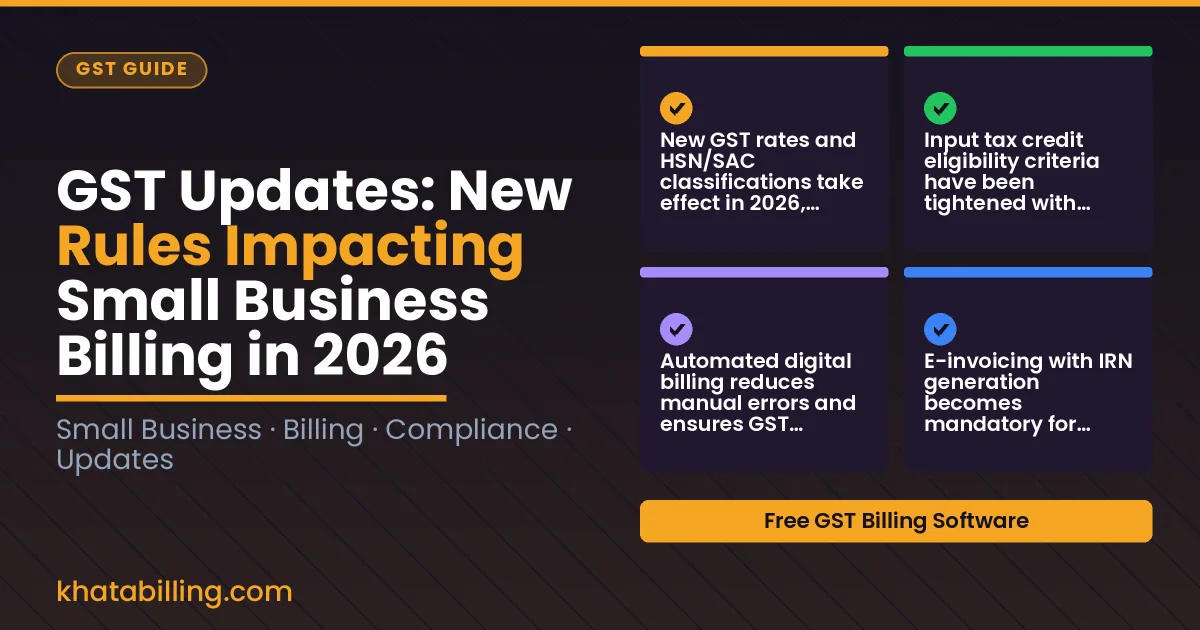
- New GST rates and HSN/SAC classifications take effect in 2026, requiring updated billing systems.
- Input tax credit eligibility criteria have been tightened with clearer documentation requirements for 2026.
- Automated digital billing reduces manual errors and ensures GST compliance across all business types.
- E-invoicing with IRN generation becomes mandatory for eligible businesses starting 2026.
- Manual billing processes are slower and error-prone compared to automated GST solutions.
- Khata Billing's Premium plan offers unlimited invoicing and advanced GST reports for full compliance.
- Preparing now with digital billing tools ensures your business stays GST-ready in 2026.
GST Rate Changes and HSN/SAC Classification Updates for 2026
GST Updates for 2026 introduce revised tax rates and modified HSN/SAC classifications that directly impact small business billing across retail, FMCG and service sectors. Effective 1 April 2026, the 18% GST rate on packaged FMCG goods is reduced to 12% for essential items like medicines, while 28% rates on certain processed foods are revised to 18% to align with consumer affordability goals. Additionally, new HSN codes 9120 and 9121 now cover health and wellness services, and SAC 91299 replaces old 9129 for digital service bundles. Shopkeepers and traders must verify that their invoice HSN/SAC fields reflect these changes to prevent filing mismatches, as GSTN validation will reject entries with outdated codes. For example, a grocery store selling herbal supplements must now use HSN 3004 instead of 2106 to avoid audit flags. Updating invoice details ensures accurate GSTR-1 filings and correct input tax credit claims. Khata Billing — free GST billing software automates HSN/SAC selection based on your product category, ensuring compliance without manual errors. The platform enforces real-time GST rule updates, so merchants stay aligned with the latest 2026 classifications without additional effort. By adopting these updates promptly, businesses avoid penalties, maintain smooth audit trails, and keep their billing workflows fully GST-ready.
Input Tax Credit Reforms and Eligibility Criteria for 2026
GST Updates in 2026 reshape ITC eligibility, requiring small businesses to verify credit claims before filing GSTR-3B. The new rules mandate ITC reversal when inputs are used for personal purposes exceeding 5%, and e-invoice reconciliation now validates ITC claims against supplier submissions. Business owners must check eligibility using a simple checklist: confirm supplier GSTIN validity, ensure invoice matches e-invoice portal records, verify business-use percentage, and confirm no personal consumption exceeds the 5% threshold. For example, a Delhi bakery buys 10 kg flour at ₹500/kg (18% GST), generating ₹90 ITC. If 600g is used for staff meals (5% personal use), ₹54 ITC must be reversed. The free plan on Khata Billing allows 10 invoices daily, up to 100 monthly, enabling accurate entry of such transactions. Similarly, a Jaipur textile shop purchases 50 meters of cotton at ₹300/meter (5% GST), totaling ₹150 ITC; if 3 meters are for personal use, ₹18 ITC reverses. The Premium plan at ₹999/year removes invoicing limits, supporting larger volumes. Always consult a CA for filing decisions. Khata Billing blog
Worked Example — Calculating GST and ITC on a Sample Retail Invoice
This worked example shows GST Updates impact on a ₹5,000 retail invoice using current rates and Khata Billing's POS billing system. Follow these steps for accurate calculation:
- Calculate total taxable value including GST: For a 18% GST rate on ₹5,000, taxable value is ₹5,000 and GST amount is ₹800, making the total invoice ₹5,800. Khata Billing's free plan covers 10 invoices a day, up to 100 in any 30-day period, so ensure your daily count stays within this limit.
- Check input credit eligibility: If you purchased goods worth ₹3,000 with 18% GST (₹540 input credit), this reduces your net payable GST. Khata Billing's free plan allows 1 bank account and 1 cash account, so track these purchases against your eligible input credit.
- Determine net GST payable: Subtract input credit (₹540) from calculated GST (₹800) to get ₹260 net payable. The cash outflow is ₹260, not the full ₹800, thanks to input credit on prior purchases.
- Apply 2026 rate changes: If GST rates increase to 22% on similar items, the taxable value becomes ₹5,000 and GST rises to ₹1,100. The new total invoice amount is ₹6,100, increasing cash outflow to ₹560 after input credit adjustments. This shows how GST Updates directly affect your bottom line.
- Verify invoice details: Ensure your POS billing system generates correct invoice numbers and applies the right GST rates automatically. Khata Billing's POS billing system handles barcode scanning and stock adjustments, reducing manual errors in these calculations.
See more about POS billing system.
Step-by-Step — Automating GST Compliance with Digital Billing
GST Updates require small businesses to adapt billing processes for 2026 compliance. Start by opening Khata Billing and selecting the Create Invoice option. Enter the customer’s GSTIN to auto-populate GSTIN, CGST, SGST, and IGST rates based on HSN code. Choose the correct HSN code for each item from the dropdown; this ensures GST calculation accuracy. The system automatically applies the correct tax percentages and updates the taxable amount. After filling item details, click Generate. The invoice will display the correct GST breakdown and total in INR. For party ledger reconciliation, navigate to the Party Ledger module. The digital system auto-syncs each invoice transaction with the respective party’s balance, eliminating manual entry errors. Export the reconciliation summary as a CSV file for your Chartered Accountant’s review. This summary includes opening balance, transaction list, and closing balance, all GST-compliant. To generate GSTR-1 and GSTR-3B ready data, go to Reports, select GST Summary, and choose the filing period. The exported file contains all required fields, including invoice numbers, taxable value, CGST, SGST, and IGST amounts. Use Custom invoice formats to match your shop’s branding while staying GST-ready. The process saves hours each month and ensures audit readiness. Manual register vs digital billing shows faster reconciliation and zero tax calculation mistakes.
Comparison Table — Manual GST Workflows vs Automated GST Billing
Manual GST workflows rely on physical registers and spreadsheets, which force shopkeepers, retailers and wholesalers to re-enter transaction details multiple times. This slow data entry process creates delays between the point of sale and GST compliance, increasing the risk of mismatched HSN codes and calculation errors. In contrast, automated digital billing captures transaction data instantly at the billing counter, eliminating duplicate entry and ensuring accurate HSN classification, which reduces error rates in HSN classification. Automated systems also streamline GSTR-1 preparation by auto-populating fields from validated invoices, cutting preparation time from days to minutes, while manual methods require manual aggregation of sales data from multiple sources. ITC reconciliation accuracy improves dramatically in automated billing because the system matches input tax claims with output tax liabilities in real time, whereas manual registers often miss entries or miscalculate credit eligibility. The cash flow impact is significant: delayed invoice generation in manual workflows ties up working capital, while automated billing enables same-day billing, faster customer payments and smoother UPI settlements. Khata Billing's free plan covers 10 invoices a day, up to 100 in any 30-day period, and offers basic GST invoicing that helps small businesses start digitising without upfront cost, while Premium unlocks unlimited invoicing and advanced reconciliation tools.
E-Invoicing Mandate and IRN Generation for 2026
Under the 2026 e-invoicing mandate, businesses with an annual turnover exceeding ₹10 crore must generate an Invoice Registration Number (IRN) through the GSTN portal in real time, a requirement that also applies to any entity voluntarily opting in for enhanced compliance; Khata Billing automates this process by capturing invoice details at the point of entry and instantly transmitting them to the IRN portal via API, eliminating manual form-filling and reducing error risk.
The e-invoice workflow requires the seller to input the supplier’s GSTIN, buyer’s GSTIN, item-wise HSN code, taxable value, CGST, SGST or IGST rates, and the applicable GST rate; Khata Billing then validates the data against GST law, generates the IRN, and embeds a dynamic QR code on the printed or digital invoice that customers scan to verify authenticity and trigger automatic GSTR-1 filing, ensuring the invoice data appears in the taxpayer’s return within minutes without additional effort.
For small traders and retailers, this shift simplifies compliance because the QR code replaces the need for physical stamp papers and manual reconciliations, while auto-populated GSTR-1 data means the daily sales summary aligns perfectly with the return, preventing mismatches that trigger audits; moreover, digital tax invoices stored in Khata Billing’s cloud ensure that even if a paper copy is lost, the seller retains a legally valid record accessible from any device, making return filing faster and audit-ready without hiring extra staff.
Future-Ready Billing — Preparing Your Business for 2026 GST Compliance
GST Updates in 2026 will reshape small business billing with revised GST rates, expanded ITC eligibility, mandatory e-invoicing and digital workflows. To stay compliant, first audit your current GSTIN-linked invoicing process, confirming your daily and monthly invoice limits. Check if your system supports real-time barcode scanning for HSN/SAC codes, as new rules demand precise code selection and automatic validation. Next, train staff on updated ITC criteria, especially for inputs like solar power and cloud services, and ensure every employee understands how to assign correct HSN/SAC codes on every invoice. Finally, adopt automation to eliminate manual entry errors; use tools that sync inventory, POS and billing data in real time, enabling seamless GSTR-1 filing and reducing late fees. Khata Billing's free plan covers 10 invoices a day, up to 100 in any 30-day period, while Premium offers unlimited invoicing and watermark-free templates. Start by creating a checklist: verify invoice count limits, confirm barcode integration, schedule ITC and HSN training, and implement a cloud-based system for instant data sync. This proactive approach ensures your business meets 2026 compliance without costly disruptions.
GST Updates in 2026 introduce clearer e-invoicing requirements and simplified GST filing for small businesses, directly affecting daily billing operations across India. These changes ensure your shopkeeper, retailer, or service provider can maintain accurate records while reducing compliance stress, with real-time data sync at the billing counter and automated stock adjustments in the warehouse.
Implement these practices immediately to stay ahead of regulatory shifts, and Start free with Khata Billing by visiting Start free with Khata Billing to experience seamless GST-compliant invoicing from day one.